Author: AndyN

  • How mindfulness can help you.

    Mindfulness is taking notice of the present moment, without judgement with a deeper sense of being here right now. This can improve your focus and help you to overcome stress, anxiety, and depression. It can also help with chronic pain, which is what the technique was first developed for.

    How to practice mindfulness.

    Mindfulness can be practised by paying attention to your senses, physical sensations in your body, and breath as a form of meditation. Popular things like gardening or yoga often give us this kind of experience, but you can build on it in a few simple ways and use the technique in many aspects of daily life. By doing so, and becoming more aware of your thoughts and feelings, you can manage them in a more helpful, positive way. It’s not about stopping the negative thoughts completely, but about noticing how they come and go in your mind and guiding your attention. Here are some simple suggestions:

    Mindfulness Idea 1:

    Take a pause in your day and notice five things you can see, then four things you can hear, three physical sensations you can feel, two things you can smell, and one thing you can taste.

    It’s all about what’s happening right now.

    Mindfulness Idea 2:

    It’s easier than you think to do daily activities in a mindful way. Notice the feeling of water and temperature on your body while you’re taking a shower. Eat a meal without distractions and savour the flavours. Notice the taste and sensation when you’re cleaning your teeth.

    Mindfulness Idea 3:

    It can be helpful to set a beep, chime or reminder on your phone every hour (or few hours), just to prompt yourself to have a 30 second pause. Put your feet on the floor, notice the contact points between your body and your seat, and take some deep breaths.

    It’s also good to use these timers as a prompt to go outside, or into your garden for a breath of fresh air

    Mindfulness Idea 4:

    Notice when you’re feeling tense and take a moment to pause. Sense your breath moving in to the tense areas of the body, then practice releasing or softening the tension with each out-breath or exhalation.

    Try this next time you’re in the car stopped at a red light.

    Mindfulness Idea 5:

    When you’re making a brew, get in the habit of having a sway and a stretch. If you work sat at a desk, bring some regular movement to your work area – even simple chair exercises can help.

    Pay special attention to the sensations in your body and your breathing while you’re doing it.

    Mindfulness Idea 6:

    Like anything, mindfulness becomes easier – and starts to make more sense – the more you practice. It isn’t for everyone, but for many the impact is huge. You can find lots of apps and online resources that can help you to learn the technique.

  • The benefits of meditation

    The lists of benefits are long and wide ranging but here is a short list that most people would find beneficial:

    1. Reduced stress by improving stress related conditions.
    2. Improved memory through better focus, mental clarity, and increased attention spans.
    3. Lower blood pressure: People who meditate regularly have lower stress related problems. This can reduce strain on the heart and blood vessels and help prevent heart disease.
    4. Less anxiety through an improved perspective, and by consequence, less likely to suffer from depression.
    5. Greater compassion: Meditation can help you better understand yourself, find your best self, and increase positive feelings and actions toward others.

    What is meditation?

    There are various types of meditation but broadly they all aim to help focus awareness on cultivating present-moment awareness (mindfulness), cultivate feelings of compassion, love, and goodwill towards oneself and others (loving kindness), or to transcend ordinary thinking and experience a state of pure awareness and consciousness (transcendental).

    Does it mean becoming more monk-like?

    Whilst some people do indeed spend their whole lives committed to enlightenment of the soul, the majority of people just want a way to relax and ‘let go’. A growing number of people are suffering from anxiety and depression in the modern world. As stress builds in response to ever-increasing demands and distractions, so too does the number of people looking for release from it all. One of the methods that people are turning to, to rediscover their inner peace and happiness, is meditation. Just a few minutes, two or three times a week, can yield impressive results.

    What is the simplest method to get started?

    There is no single ‘correct method’ but if you follow these simple steps, it will help get you started:

    1. Sit or stand in a calm, quiet place with eyes closed or gaze down.
    2. Set a time limit, especially if you’re just starting out. It can be five or 10 minutes.
    3. Feel your body. Make sure you are stable and in a position you comfortably stay in the whole time.
    4. Focused attention practice: Focus your attention on your breathing in two ways. First, you can observe your torso expanding and contracting. Or you can feel the sensation of breath inside your nostrils with each inhalation and exhalation. When your breath focus is stable, you can shift to noticing thoughts, emotions, sensations, and sounds as they rise and dissolve in your mind.
    5. Notice when your mind wanders, which will happen. Don’t be hard on yourself when your mind goes elsewhere – just note where your mind drifted and then gently return your attention to your breath.
    6. Slowly return from your meditation feeling relaxed and replenished.

  • Finding joy through artistic expression

    Whether you like to create your own work or simply experience it; art has the power to evoke and amplify joy. Taking things to the next level by engaging in the creation of art can be a form of escape, providing a break from the daily stresses of life, and a significant factor in promoting an inner connection.

    How do I get started?

    Explore different art forms: Try different mediums like painting, sculpture, music, acting, or poetry. Explore and find what resonates with you. If you find yourself doodling with a pen in hand, singing along with the radio, or enjoy writing (in any form) then use prompts like these to steer yourself to the places where you will find more of the same. Visit museums and galleries, go to the local theatre, write out a fantastic experience as though you’ve already done it. Expose yourself to a variety of art and find pieces that inspire you. If drawing and painting is your chosen route, you might start by being more mindful of your surroundings: Look for the beauty in the everyday things and find joy in the simple pleasures of creating art from what you have found.

    “I dont think I’m good enough to produce anything worthwhile”.

    It can be daunting to produce something for the first time. Whether it be music from an instrument, a story, a pot, a poem, or a sketch. It’s the fear of being judged and found wanting that stops us from ever trying a new activity. However, there is a fact that for some inexplicable reason is not well known: The fact is that if you if you join any community of skilled artists (in whatever field) then you will get lots of praise, encouragement, and ideas on how to progress. The reason for the help you will receive is simple. Every artist, no matter how accomplished, had a ‘first day’, there was a time in their lives when they produced a ‘first piece’ and they remember how it felt. By joining an online group, going to a class, etc, you will be surrounded by like minded people that have been where you are now, and if you’re prepared to ‘have a go’ they will help and encourage you.

    Finally..

    Revel in the art form of your choice. Enjoy the connected experience: Enjoy your sense of personal growth: More than anything else; feel the joy of doing something creative just for you.

  • Poem: Joyful living

    Joyful living means forgiving;

    embracing life without misgiving.

    Choosing to make the best of things,

    no matter what tomorrow brings.

    Roll with it and keep up your smile,

    things will feel better in a while.

    An optimistic point of view,

    is your best tool for getting through.

    Don’t dwell on things when life feels tragic,

    remember too, its full of magic.

    Find your balance, its a tightrope,

    things turn out best for those who have hope.

    Life gives us choices every day,

    make choices that bring joy your way.

    Today is yours, to lose or win,

    expect the best, lift up your chin,

    learn from mistakes, it’s what they’re for,

    you’re adding to your coping store.

    Our lives are finite, make yours count,

    live life with joy, don’t cling to doubt,

    live in the moment, let hurt go,

    watering regrets just makes them grow.

    Life’s more than just trying to survive,

    and, no-one gets out of this world alive!

    (Written with a moments notice, by my dear friend Bridget, 12th April 2020)

  • Emotional literacy

    Why bother with emotional literacy?

    To be in a more mindful state you will need to be in a position to understand what your body (and subconscious mind) is informing you of. Your conscious mind takes in visual, audio, touch, taste, and smell stimulus to interpret and act on. In addition there will be emotional stimulus that manifest throughout the body and conscious mind as feelings. Your subconscious wants keep you to be safe and thrive. If you understand these prompts and act on them then all is well. Yet, if you fail to respond they will become more intense and dramatic over time. This is why you see/ feel a dissonance between what people are saying and what they are actually doing. These seemingly unrelated emotional responses can seem mysterious and overwhelming until we investigate a little deeper to understand the information that they offer us.

    Plutchik's wheel of emotions

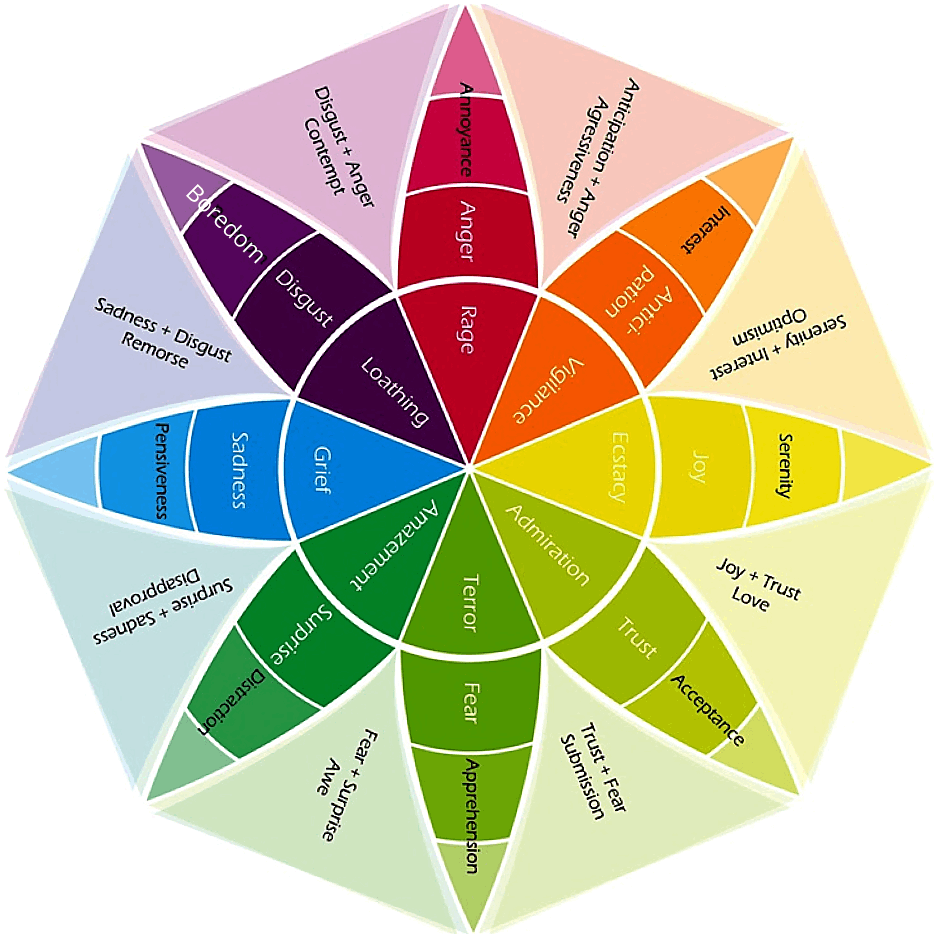
    Plutchik’s wheel of emotions:

    Psychologist Robert Plutchik helps us visualise 8 primary emotions: joy, trust, fear, surprise, sadness, anticipation, anger, and disgust by use of a coloured wheel. It illustrates the emotions and the ways they relate to each other.

    Primary emotions: are grouped into polar opposites that are opposite each other on the wheel – Joy > Sadness, Acceptance > disgust, Fear > Anger, Surprise > Anticipation arranged into colours to establish a sets of similar emotions.

    Layers: Moving toward the centre of the wheel intensifies the emotion.

    Relations: The spaces between the emotions demonstrate combinations of the adjoining primary emotions.

    Working with emotions:

    There are other models but Plutchik’s visualisation is found by many as an easy way to start to simplify complex concepts. A useful method is to think of feelings and emotions as information. This helps us to be more mindful of where we are at any given point so we can separate (for example) the feeling of being angry from escalating into an actual outburst of rage. Another example might be; we are in the midst of a crowd and feeling lonely. If we use the technique of writing down our feelings, as we reflect on the day, we can use Plutchik’s wheel to make sense of underlying emotions that might otherwise be confusing.

    Using our emotional literacy in the moment:

    Now that we have a way of unravelling complex emotions (and putting a name to them) we have the emotional literacy we need to put it all into words. Speaking something out (and/ or writing it down) is a great way to recognise, not only what our emotions are telling us, but also to enable us to take action in the moment the next time they occur and thus completely avoid them ever getting to a point where it becomes a major project to undo the harm that may have been done.

  • Life Gems and Inner potential

    Humans have pondered about finding purpose and direction to their lives for aeons.

    Whether reading of a farmer, painter, scientist, parent, or emperor of a nation the underlying questions we hear again and again are, “Is this it? Is there nothing more?”

    So, where should you start?

    Let us dare to imagine a world where we exist healthily with each other, ourselves, and nature. A place where we can thrive through realising our own inner potential.

    And…

    Let us state the gratitude we have for being given a life. Life is a miracle and you are part of it. You share the wonderful gift of life with everyone else who is living right now, here on this little rock called Earth.

    How to start then?

    There will be some work to be done that would be well served with some kind of self authoring process to help you explore your past, present, and future (try doing some research online to find out what I mean by this).

    It could be argued that one answer is to stop wanting more and with possessions that would certainly be a valid point. Yet, what of knowledge, personal fulfilment, and service to others? Decide what it is that you hope to achieve whilst you are here and then set about doing it with effort.

    Shared experience is a wonderful thing. By listening to the wisdom of those that came before us we save ourselves from retreading a path that has already been trodden without success. Many ideas have been tried and cast aside but those that have stood the test of time are generally simple truths.

    I’m certainly not going to be able to provide you with the answers you seek for your ultimate purpose in this humble space yet I can offer you some of the ‘Life gems’ that I picked up whilst I was going through the same process.

    Please take time to browse through the other blogs here and pick out the ones that jump out as most relevant to you.

  • Uncover your existing purpose

    Your existing purpose is something that you have been unconsciously doing already. It can usually be summed up in a short sentence that encapsulates who you are in a powerful statement about why you’re here, and what you’re here to do.

    Once you know your purpose it can help you stay on track. The knowledge of what you are here for can help you decide on the fly, “should I do this or should I do that?”

    Of course, you can exercise your gift of free will at any point, yet if one choice fulfils your purpose – your life will tend to run more smoothly (than running with one that that does not). Additionally, when you bring yourself more closely inline (in an involved and doing way), you may feel that your life energy flows more freely.

    A method to discover your purpose:

    It is perfectly possible to pass this task to your subconscious power-house by simply asking, “I want to know my purpose and I want the answer to come to me in the form dreams and spontaneous insight”. The latter would work just fine yet I found that it needed a more systematic approach to tease out the information I needed. This is how I did it;

    Stage 1: Begin by looking back on your life. Take a blank piece of paper (lets say – A4 size) – put a diving line down the centre and write at the top of one side, “Things I enjoyed and wanted to do” .. and on the top of the other side write, “Things I would rather not have done”. Then leave that piece of paper out, and over time (lets say – a week), put a brief description, under each of your headings, of actions or activities you have done in the past. Try to fill each side of the dividing line right down to the bottom of the page with as many varied examples as come to mind.

    Stage 2: Take a look at each column and try to find any commonality between each listed item on each side of the page. You might notice a lot of sport, mediation between people, leadership, working in teams, or creativity and lone working. Take a new piece of paper and again put a dividing line down the middle. This time – make one heading ‘More like me’ and the other heading ‘Less like me’. Read through your previous listings and jot down the essence of each type of action/ activity under the relevant heading. You should now have two shorter lists that give you a pretty good idea of your inclinations, this way or that way, based on what you have already been doing in your life.

    Stage 3: Finally, examine the previous two lists and try (by trial and error if you like) to ‘boil down’ the list of ‘More like me’ to a single sentence (that usually begins with “I am..”), like – “I am a joyful liver of life”, “I learn then I teach”, “I intensely appreciate life”. If these descriptions seem too vague, then go for one that is a little more specific – “I am a light-hearted creator for peace”, “I am a talkative vessel for highlighting happiness”, “I am a festive organiser of people”, “I am a silent contributor to a peaceful world”, etc.

    If you have been feeling that your life hasn’t been quite as you hoped, or as ran as completely as you might, then knowing your purpose might just answer that question, “Why am I here?”

    Try it out – enjoy the process, gain some new insight, and have fun!

  • Web design

    Cartoon of Graphic Designer

    It can be daunting to create your own web site, yet with a little advice and guidance you can be up and running in less time than you might think. I have included some information below to get you started.

    Note: I don’t charge for advice on small web sites or those small non-profit groups that offer help to others.

    Checklist clipboard

    Getting online:

    Straight forward information in plain English to take the mystery out of creating the components of your web site.


    There are 3 simple tasks to building your website (think of them as the foundations for your site and the content as the building that sits on them):

    1. Choosing a web address: Your web address is called your domain name (i.e. www.mydomain.com). The domain name is typed into a web browser as a search request which the web then uses to return the matching domain web pages so that the user can click on its links and menu’s to navigate around. The simplest approach here is to follow conventions that other sites are using. It is ‘usual’ for your website to have address to closely resemble the name you will be using that also an ending that reflects your location (e.g. mydomain.com for an American business, mydomain.co.uk for a UK business, mydomain.org for an organisation, and mydomain.gov.uk for UK government departments). After you have chosen a name for your site – go to one of the domain name registrars to see if its available. Many names will already be taken but be persistent and creative with your ideas until you settle on a choice and make your purchase (typically around £10 for a year). Many of these registrars now provide complete solutions to easily build your site but you do not HAVE to be ‘tied in’ to their monthly costs if you simply wish to purchase a domain name.
    2. Selecting a web host: Once you have a domain name you will need somewhere to base the files that make up the pages of your new website. This is where the web will be directed to when someone types your domain name into a web browser. Many of the hosting companies also provide complete solutions for building a complete web site but yet again you do not need to purchase any more than the space required to host your web files (around £20 per year).
    3. Deciding on the layout of your web pages: You will want to create a design that is particular to you but has a familiar ‘feel’ to it. The easiest way to do this is to have look at other websites that are similar to what you do and then adapt their common themes to suit the look and feel you are looking for. You can have things as simple or as complicated as you wish but do remember that the more complicated it is the more cost and work is involved in maintaining it. The simplest form of layout is little more than a glorified business card (that tells your visitors what it is that you do and how they should contact you). If you want to have a few products and services then this need not be onerous but if you want an online shop with many products or a website with a complex structure then you will need to enlist the help of a web designer to help create the site and then help you with any problems that may arise when its up and running.
    Collection of logo designs

    Logos and Graphics:

    Advice and services on how to create graphical and logo designs for your web site.

    Take a look around this site and you will see examples of a logo (at the head of each page), photos, and some simple graphics that fit in with the overall design and help to make the layout aesthetically pleasing to use.

    If you have an artistic flare it maybe worth you purchasing and learning how to use one the many ‘Vector Graphics’ software applications. It does take some commitment yet the time taken is well worth the effort if you are interested in creating your own artwork.

    Most people are busy and really don’t have the additional time to create their own graphics Instead they browse through online catalogues of existing graphics to purchase what they need or simply ask like us to help create the bespoke designs that are needed.

    Cartoon of Female Manager

    Managing your website:

    In this section I take you through how to manage the various components that make up your website.

    Once you are up and running you will need to maintain the content of your web site and set yourself some reminders to renew the domain name registration and the hosting package.

    The layout of your site will change very little over time but you may want to edit the content of the pages to keep them relevant. You can do this yourself with one of the many web designing tools (often with a monthly fee) or we can show you how to use free software that will allow you to get ‘under the bonnet’ and change things quite easily for yourself.

    If the fear of breaking something fills you with dread, or (again) you simply don’t have the time available; then we can do the updates for you at a nominal price.