
Why bother with emotional literacy?
To be in a more mindful state you will need to be in a position to understand what your body (and subconscious mind) is informing you of. Your conscious mind takes in visual, audio, touch, taste, and smell stimulus to interpret and act on. In addition there will be emotional stimulus that manifest throughout the body and conscious mind as feelings. Your subconscious wants keep you to be safe and thrive. If you understand these prompts and act on them then all is well. Yet, if you fail to respond they will become more intense and dramatic over time. This is why you see/ feel a dissonance between what people are saying and what they are actually doing. These seemingly unrelated emotional responses can seem mysterious and overwhelming until we investigate a little deeper to understand the information that they offer us.
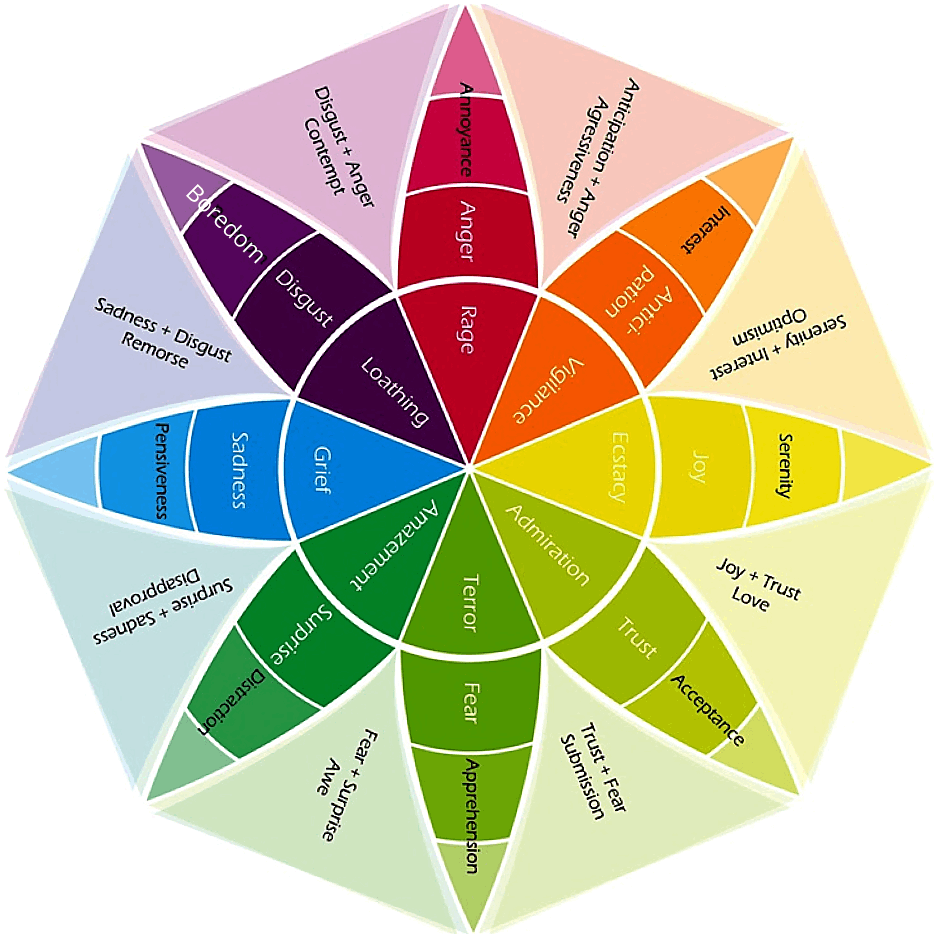
Plutchik’s wheel of emotions:
Psychologist Robert Plutchik helps us visualise 8 primary emotions: joy, trust, fear, surprise, sadness, anticipation, anger, and disgust by use of a coloured wheel. It illustrates the emotions and the ways they relate to each other.
Primary emotions: are grouped into polar opposites that are opposite each other on the wheel – Joy > Sadness, Acceptance > disgust, Fear > Anger, Surprise > Anticipation arranged into colours to establish a sets of similar emotions.
Layers: Moving toward the centre of the wheel intensifies the emotion.
Relations: The spaces between the emotions demonstrate combinations of the adjoining primary emotions.
Working with emotions:
There are other models but Plutchik’s visualisation is found by many as an easy way to start to simplify complex concepts. A useful method is to think of feelings and emotions as information. This helps us to be more mindful of where we are at any given point so we can separate (for example) the feeling of being angry from escalating into an actual outburst of rage. Another example might be; we are in the midst of a crowd and feeling lonely. If we use the technique of writing down our feelings, as we reflect on the day, we can use Plutchik’s wheel to make sense of underlying emotions that might otherwise be confusing.
Using our emotional literacy in the moment:
Now that we have a way of unravelling complex emotions (and putting a name to them) we have the emotional literacy we need to put it all into words. Speaking something out (and/ or writing it down) is a great way to recognise, not only what our emotions are telling us, but also to enable us to take action in the moment the next time they occur and thus completely avoid them ever getting to a point where it becomes a major project to undo the harm that may have been done.
Leave a Reply