
Category: SimpleGem Info

  • Emotional literacy

    Why bother with emotional literacy?

    To be in a more mindful state you will need to be in a position to understand what your body (and subconscious mind) is informing you of. Your conscious mind takes in visual, audio, touch, taste, and smell stimulus to interpret and act on. In addition there will be emotional stimulus that manifest throughout the body and conscious mind as feelings. Your subconscious wants keep you to be safe and thrive. If you understand these prompts and act on them then all is well. Yet, if you fail to respond they will become more intense and dramatic over time. This is why you see/ feel a dissonance between what people are saying and what they are actually doing. These seemingly unrelated emotional responses can seem mysterious and overwhelming until we investigate a little deeper to understand the information that they offer us.
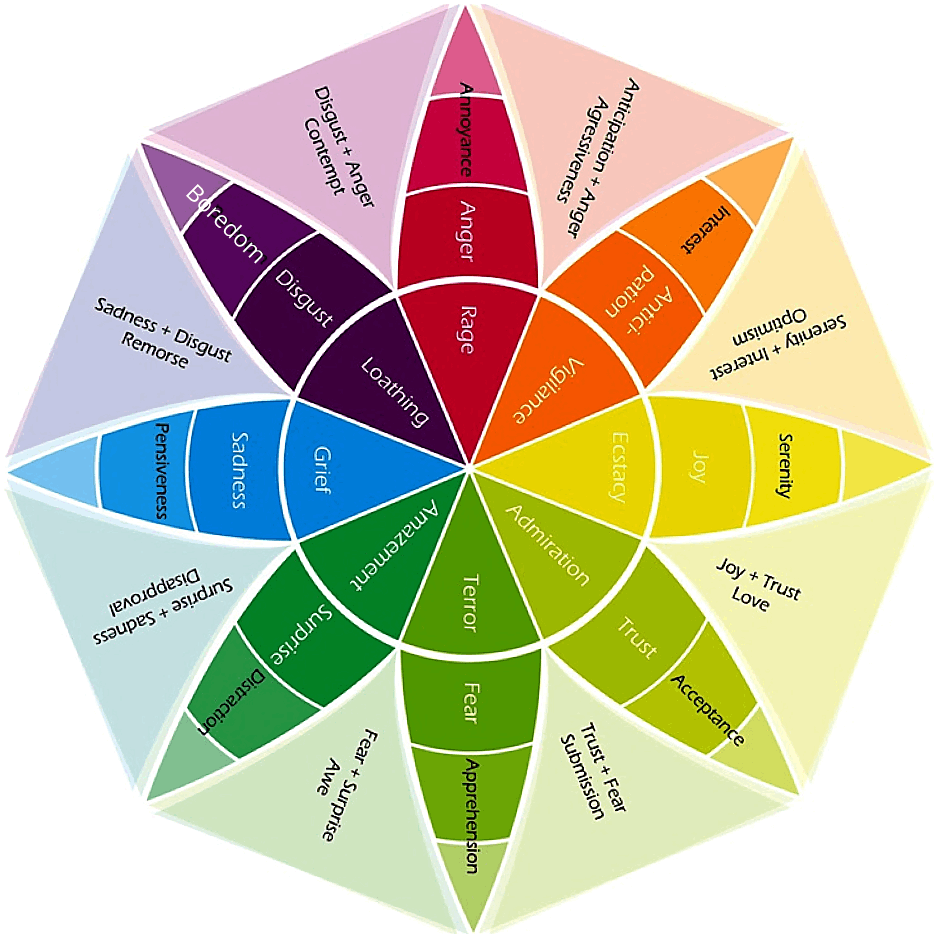
    Plutchik's wheel of emotions

    Plutchik’s wheel of emotions:

    Psychologist Robert Plutchik helps us visualise 8 primary emotions: joy, trust, fear, surprise, sadness, anticipation, anger, and disgust by use of a coloured wheel. It illustrates the emotions and the ways they relate to each other.

    Primary emotions: are grouped into polar opposites that are opposite each other on the wheel – Joy > Sadness, Acceptance > disgust, Fear > Anger, Surprise > Anticipation arranged into colours to establish a sets of similar emotions.

    Layers: Moving toward the centre of the wheel intensifies the emotion.

    Relations: The spaces between the emotions demonstrate combinations of the adjoining primary emotions.

    Working with emotions:

    There are other models but Plutchik’s visualisation is found by many as an easy way to start to simplify complex concepts. A useful method is to think of feelings and emotions as information. This helps us to be more mindful of where we are at any given point so we can separate (for example) the feeling of being angry from escalating into an actual outburst of rage. Another example might be; we are in the midst of a crowd and feeling lonely. If we use the technique of writing down our feelings, as we reflect on the day, we can use Plutchik’s wheel to make sense of underlying emotions that might otherwise be confusing.

    Using our emotional literacy in the moment:

    Now that we have a way of unravelling complex emotions (and putting a name to them) we have the emotional literacy we need to put it all into words. Speaking something out (and/ or writing it down) is a great way to recognise, not only what our emotions are telling us, but also to enable us to take action in the moment the next time they occur and thus completely avoid them ever getting to a point where it becomes a major project to undo the harm that may have been done.


  • Life Gems and Inner potential

    Humans have pondered about finding purpose and direction to their lives for aeons.

    Whether reading of a farmer, painter, scientist, parent, or emperor of a nation the underlying questions we hear again and again are, “Is this it? Is there nothing more?”

    So, where should you start?

    Let us dare to imagine a world where we exist healthily with each other, ourselves, and nature. A place where we can thrive through realising our own inner potential.

    And…

    Let us state the gratitude we have for being given a life. Life is a miracle and you are part of it. You share the wonderful gift of life with everyone else who is living right now, here on this little rock called Earth.

    How to start then?

    There will be some work to be done that would be well served with some kind of self authoring process to help you explore your past, present, and future (try doing some research online to find out what I mean by this).

    It could be argued that one answer is to stop wanting more and with possessions that would certainly be a valid point. Yet, what of knowledge, personal fulfilment, and service to others? Decide what it is that you hope to achieve whilst you are here and then set about doing it with effort.

    Shared experience is a wonderful thing. By listening to the wisdom of those that came before us we save ourselves from retreading a path that has already been trodden without success. Many ideas have been tried and cast aside but those that have stood the test of time are generally simple truths.

    I’m certainly not going to be able to provide you with the answers you seek for your ultimate purpose in this humble space yet I can offer you some of the ‘Life gems’ that I picked up whilst I was going through the same process.

    Please take time to browse through the other blogs here and pick out the ones that jump out as most relevant to you.

  • Web design

    Cartoon of Graphic Designer

    It can be daunting to create your own web site, yet with a little advice and guidance you can be up and running in less time than you might think. I have included some information below to get you started.

    Note: I don’t charge for advice on small web sites or those small non-profit groups that offer help to others.

    Checklist clipboard

    Getting online:

    Straight forward information in plain English to take the mystery out of creating the components of your web site.


    There are 3 simple tasks to building your website (think of them as the foundations for your site and the content as the building that sits on them):

    1. Choosing a web address: Your web address is called your domain name (i.e. www.mydomain.com). The domain name is typed into a web browser as a search request which the web then uses to return the matching domain web pages so that the user can click on its links and menu’s to navigate around. The simplest approach here is to follow conventions that other sites are using. It is ‘usual’ for your website to have address to closely resemble the name you will be using that also an ending that reflects your location (e.g. mydomain.com for an American business, mydomain.co.uk for a UK business, mydomain.org for an organisation, and mydomain.gov.uk for UK government departments). After you have chosen a name for your site – go to one of the domain name registrars to see if its available. Many names will already be taken but be persistent and creative with your ideas until you settle on a choice and make your purchase (typically around £10 for a year). Many of these registrars now provide complete solutions to easily build your site but you do not HAVE to be ‘tied in’ to their monthly costs if you simply wish to purchase a domain name.
    2. Selecting a web host: Once you have a domain name you will need somewhere to base the files that make up the pages of your new website. This is where the web will be directed to when someone types your domain name into a web browser. Many of the hosting companies also provide complete solutions for building a complete web site but yet again you do not need to purchase any more than the space required to host your web files (around £20 per year).
    3. Deciding on the layout of your web pages: You will want to create a design that is particular to you but has a familiar ‘feel’ to it. The easiest way to do this is to have look at other websites that are similar to what you do and then adapt their common themes to suit the look and feel you are looking for. You can have things as simple or as complicated as you wish but do remember that the more complicated it is the more cost and work is involved in maintaining it. The simplest form of layout is little more than a glorified business card (that tells your visitors what it is that you do and how they should contact you). If you want to have a few products and services then this need not be onerous but if you want an online shop with many products or a website with a complex structure then you will need to enlist the help of a web designer to help create the site and then help you with any problems that may arise when its up and running.
    Collection of logo designs

    Logos and Graphics:

    Advice and services on how to create graphical and logo designs for your web site.

    Take a look around this site and you will see examples of a logo (at the head of each page), photos, and some simple graphics that fit in with the overall design and help to make the layout aesthetically pleasing to use.

    If you have an artistic flare it maybe worth you purchasing and learning how to use one the many ‘Vector Graphics’ software applications. It does take some commitment yet the time taken is well worth the effort if you are interested in creating your own artwork.

    Most people are busy and really don’t have the additional time to create their own graphics Instead they browse through online catalogues of existing graphics to purchase what they need or simply ask like us to help create the bespoke designs that are needed.

    Cartoon of Female Manager

    Managing your website:

    In this section I take you through how to manage the various components that make up your website.

    Once you are up and running you will need to maintain the content of your web site and set yourself some reminders to renew the domain name registration and the hosting package.

    The layout of your site will change very little over time but you may want to edit the content of the pages to keep them relevant. You can do this yourself with one of the many web designing tools (often with a monthly fee) or we can show you how to use free software that will allow you to get ‘under the bonnet’ and change things quite easily for yourself.

    If the fear of breaking something fills you with dread, or (again) you simply don’t have the time available; then we can do the updates for you at a nominal price.